Northrop 2025-26 Student Matinees
Marching Band Student Matinee Pre-event Video Transcript
Follow us on Facebook, X, Instagram @NorthropUMN
Remember to keep your feet on the floor during the performance and no gum/food/drink in the theater.
The performers can see and hear you, just like you can see and hear them. Please limit talking or even whispering.
Please turn your phone OFF before the performance starts.
Exposure to the arts help K-12 students perform higher on standardized tests and achieve higher GPAs.
In Minnesota it is the law that K-12 schools provide arts education to students for a more well-rounded education.
The University of Minnesota athletic teams are known as the Golden Gophers, and the mascot, Goldy, is a fan favorite!
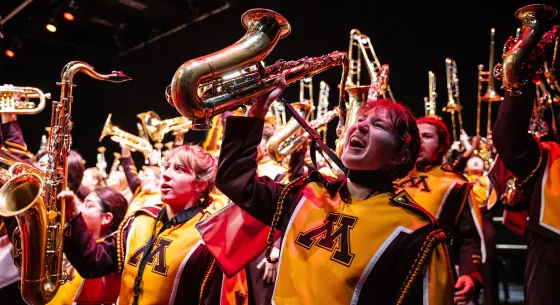
The first UMN Marching Band had 29 members when it began in 1892. Today, there are more than 300 members!
You don't have to be a music major to play in marching band. Members of the UMN Marching Band are students who study all sorts of different subjects.
The UMN Marching Band consists of brass, woodwinds, and percussion instruments.
All woodwinds produce sound by splitting the air blown into them on a sharp edge, such as a reed.
A flute sounds very bright and cheerful playing high notes.
The piccolo is a small flute that plays one octave higher than the normal flute and plays the highest notes.
The clarinet has a single-reed mouthpiece, a cylindrical tube with a flared end, and holes stopped by keys.
The saxophone was developed from the clarinet and shares many similarities. The player blows into a reed fitted in a mouthpiece of the instrument.
A brass instrument is played by blowing through and buzzing lips against a metal cup-shaped mouthpiece to make sound and change the pitch or note.
The trumpet is played by blowing into the mouthpiece and making a "buzzing" sound. The player can press three keys called valves to change the pitch.
The medium-range mellophone typically replaces the French horn in marching bands. It looks like a trumpet except for more tubing and a much larger bell.
The trombone is like a large trumpet, but the player pushes and pulls the slide to change tube length. It plays a range of notes with the slide and lip vibrations.
The low-range baritone marching horn replaces the euphonium in marching bands. It is held like the trumpet but is much larger and lower pitched.
The sousaphone is the biggest brass instrument, weighing 28 pounds with about 18 feet of tubing, and requires a lot of breath to play.
Percussion instruments are played by shaking or hitting. The UMN Marching band has a drumline with four different percussion instruments.
The snare drum is constructed of two heads—both usually made of plastic—along with a rattle of metal wires on the bottom head called the snares.
The UMN tenor drums are mounted sets of five drums, allowing one person to carry and play multiple drums simultaneously.
The bass drum is a large drum with two heads and a booming sound of low indefinite pitch. They have six bass drums of all different sizes.
Cymbals are discs usually made of copper and bronze that are played by crashing them together in different ways to create many varied sounds.
Interested in joining The Marching Band? Stick with it! Join your school's band, keep practicing and performing, and one day you can be part of The Pride of Minnesota!
Fri, Feb 6, 10:30 am
Fri, Feb 20, 10:15 am & 12:45 pm
Northrop activities are made possible by the voters of Minnesota through a Minnesota State Arts Board Operating Support grant, thanks to a legislative appropriation from the Arts and Cultural Heritage Fund.
RBC Wealth Management