Northrop Presents
Alvin Ailey American Dance Theater
Archived Past Event
Apr 18, 2026
Apr 19, 2026
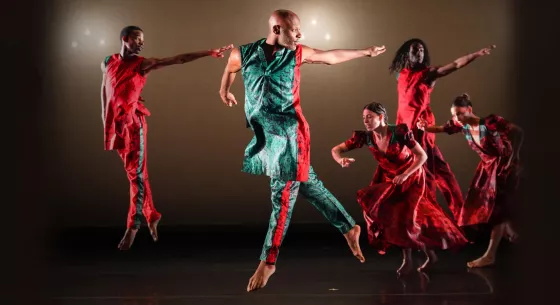
Alvin Ailey American Dance Theater returns to Northrop with more dance The New York Times calls “transfixing, pulsating and galvanizing.” Embarking on its next era under the leadership of new Artistic Director Alicia Graf Mack, the company remains guided as ever by Alvin Ailey’s pioneering legacy — continuing to push the bounds of what the human body can do and what the human spirit can achieve. Audiences will be treated to different programming each night, including some classic favorites alongside several new works by contemporary choreographers that promise to propel dance in exciting new directions. Both programs culminate with Ailey’s ultimate anthem to resilience and joy, “Revelations.”
Top photo: Alvin Ailey American Dance Theater's Caroline T. Dartey. Photo by Andrew Eccles.
“Jazz Island”
Choreography: Maija García
Music: Etienne Charles
“Difference Between”
Choreography: Mathew Neenan
Music: Heather Christian & the Arbornauts
“Song of the Anchorite”
Choreography: Jamar Roberts
Music: Maurice Ravel, performed (on recording) by Avishai Cohen, Yonathan Avishai, Barak Mori and Ziv Ravitz
“Revelations”
Choregraphy: Alvin Ailey
Music: Various Artists
“The Holy Blues”
Choreography: Jawole Willa Jo Zollar, Samantha Figgins and Chalvar Monteiro
Music: Various Artists
“Blink of an Eye”
Choreography: Medhi Walerski
Music: Johann Sebastian Bach, performed (on recording) by Itzhak Perlman
“A Case of You”
Choreography: Judith Jamison
Music: Joni Mitchell, performed (on recording) by Diana Krall
“Revelations”
Choreography: Alvin Ailey
Music: Various Artists
More than just a popular dance work, “Revelations” has become a cultural treasure. Performed to African American spirituals, song-sermons, gospel songs and holy blues, Alvin Ailey’s “Revelations” fervently explores the places of deepest grief and holiest joy in the soul. This enduring classic is born out of the choreographer's "blood memories" of his childhood in rural Texas and the Baptist Church. Since its premiere in 1960, the ballet has been performed continuously around the globe, crossing barriers of faith and nationality, making it the most widely-seen modern dance work in the world.
“Every American owes it to him or herself to see the Ailey [company] perform ‘Revelations.’ It is an American phenomenon.” — Oprah Winfrey
“The thing about the dancers of Alvin Ailey American Dance Theater is that they are precision performers — technique visible, placings academic — but at the same time, they can elasticate and undulate their bodies; they can be sensual and spiritual. Above all, they dance with great sincerity.” — The Guardian
Meet Alicia Graf Mack: “Announcing Our Next Artistic Director”
The content below derives from the Northrop Across Campus Program that supports Northrop's mission towards intersections between performing arts and education for the benefit of all participants now and for generations to come.
Find ways to make thematic connections to these suggested topics:
Dive deeper with these resources that provide additional information about the performers, the history of the artform and the artistic process.
"Alvin Ailey: A Titan of Dance, Cultural Change, and Champion of Inclusivity" — Black History Month Magazine 2025 U.K.
Video: "'Revelations' - Alvin Ailey American Dance Theater"
Video: "The life of Alvin Ailey"
Turnham, Stephanie. "Alvin Ailey and the southern black experience as portrayed in “Blues Suite” and “Revelations." PhD dissertation, Baylor University, 2002. ProQuest Dissertations & Theses (1411666).
Brown, Selena. "Crafting Americana and Choreographing Legacy: The Multicultural Approach of Lester Horton." PhD dissertation, Brown University, 2022. ProQuest Dissertations & Theses (31876316).
Alvin Ailey Blog: "Remembering Judith Jamison"
Alvin Ailey Blog: "Announcing Our Next Artistic Director: Meet Alicia Graf Mack"
"Alicia Graf Mack on Honoring the Past and Future of Dance" (Audio podcast episode) In PBS "American Masters: Creative Spark." The WNET Group.
Video: "Ailey" — PBS "American Masters"
Video: "Loving the unknown Alvin Ailey" — PBS "American Masters"
Video: "Portrait of Ailey" documentary
President Obama Announces the Presidential Medal of Freedom Recipients
"The Master of Movement: Choreographer Alvin Ailey, the Spring in America's Steps Alvin Ailey" — The Washington Post
Start a conversation about the performance or encourage reflection, using these questions as inspiration.
Alvin Ailey was born on Jan. 5, 1931, in Rogers, Texas, where he grew up with his mother, working in cotton fields and witnessing the river baptisms at their local church. These childhood experiences inspired some of his most memorable works, including "Revelations," a three-part suite that explores the places of deepest grief and holiest joy in the soul through spirituals, gospel, and holy blues music. Ailey recounted that one of America’s richest treasures was the African American cultural heritage — “sometimes sorrowful, sometimes jubilant, but always hopeful.”
Ailey experienced concert dance for the first time after moving to Los Angeles. At a time when classical dance classrooms and schools were barred to Black Americans, Ailey’s close friend, dancer Carmen de Lavallade, introduced him to Lester Horton, the founder of one of the first racially integrated dance companies in the United States, where Ailey began his formal dance training. Horton became a mentor to Ailey, and after Horton’s passing in 1953, Ailey became the director of the Lester Horton Dance Theater and began to choreograph his own works.
In 1958, Ailey founded Alvin Ailey American Dance Theater to carry out his vision of a company dedicated to uplifting the African American experience while enriching and preserving the legacy of modern dance. Ailey described his vision: “Making dances is an act of progress; it is an act of growth, an act of music, an act of teaching, an act of celebration, an act of joy.” Ailey’s work, which has been performed in 71 countries on six continents, was named by a U.S. Congressional resolution as a “vital American Cultural Ambassador to the world.”
Before Ailey’s untimely passing in 1989, he named Judith Jamison, one of Ailey's previous principal dancers, as his successor. Jamison, who passed away in 2024, led the company and expanded the joyful legacy of Ailey’s work, educating and inspiring countless people, and mentored her successor Robert Battle. Alicia Graf Mack, former principal dancer for Ailey and dean and director of the Dance Division of The Juilliard School, was named artistic director in 2025. Graf Mack reflects on the legacy of Ailey and the impact of Judith Jamison: “[She] was my north star. I kept a poster of her in my bedroom growing up, like she was my Michael Jordan. I joined the company under her direction. And she lived up to every ounce of expectation … that I had for someone of her stature. She would give incredible notes and corrections. And she would say it in the voice of Ailey.”
This activity is made possible by the voters of Minnesota through a Minnesota State Arts Board Operating Support grant, thanks to a legislative appropriation from the Arts and Cultural Heritage Fund.