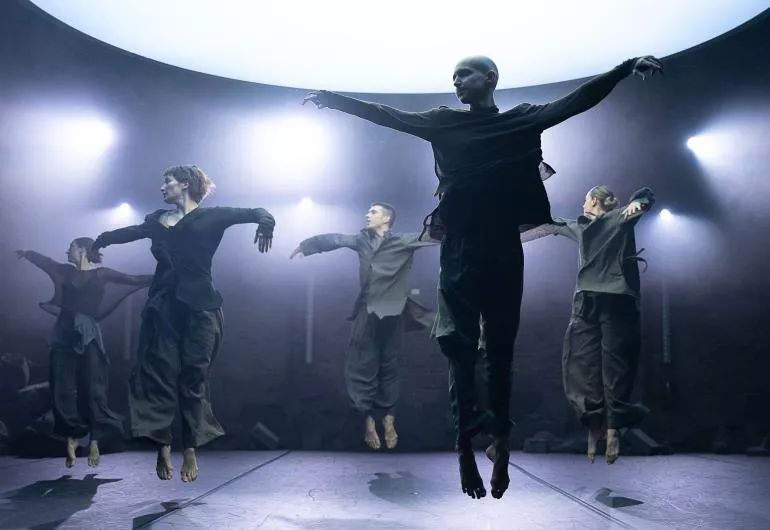
About
History & Future
Discover details about Northrop’s nearly 100-year history—from its famous pipe organ to its headline-making renovation—and learn what it plans for the next century.

Northrop was integrated into the campus life of University students, faculty, staff and others for decades. Northrop was the only large multi-purpose hall and primary arts presenter in the area. Its importance to the cultural life of the entire community from the 1930s to 1970s cannot be overstated. The University Artists Course was the original name for the programming and arts performances that came in wide variety to Northrop. Founded by Verna Scott in 1919, the Artists Course was the first such series under college or university sponsorship and was widely imitated. Classical music was the first focus and brought pianist and composer Sergei Rachmaninoff and violinist Jascha Heifetz to university audiences. Dance was later added to the series. The first dance performance, by modern dance pioneer Mary Wigman on Jan 12, 1932, was particularly bold. Northrop’s presenting function for performing arts events of all genres, popular and classical, fell under the Artists Course name until 1978, when the name was retired and became the Northrop Dance Series.
A desire to make the University a cultural center for the community included a place to “display pictures.” In April 1934, the University Art Gallery, initially known as the “Little Gallery,” occupied five small rooms on Northrop’s fourth floor. It was virtually the only place in the area where modern and American art could be viewed. The gallery later became the Weisman Art Museum.
Additionally, the Metropolitan Opera made Northrop a regular stop on its national tour beginning in 1945. Opera patrons flocked from a nine-state region and Canada to attend opera week each May. Interest remained high until the Met discontinued touring altogether in 1986.
Over the years, students have used the plaza as a gathering spot and also for protests. Convocations, free and open to the public, were held weekly in the auditorium until 1969. From 1959 to 1961 alone, choreographer Agnes DeMille, civil rights leader Martin Luther King Jr., tennis champion Althea Gibson and historian Arnold Toynbee were guest speakers. Inside, large lecture courses were held in the auditorium starting in 1959. Northrop’s basement was, until 2009, home for the 200-plus member University Marching Band.
In the 1970s, interest in dance was gaining popularity. Northrop’s seating capacity and the size of its proscenium stage made it one of the only facilities in the region with the ability to present major touring dance companies. The Northrop Dance Season was established in 1970–71 and has flourished ever since.
Fast-forward to the 21st century. After years of deferred maintenance, an extensive interior revitalization of Northrop began in 2011 by the firm HGA Architects and Engineers, ARUP Acoustical and Theatrical Consulting, and JE Dunn Construction. The project closed Northrop for three years but when the building reopened in 2014 to fanfare, the iconic building included many new multipurpose flexible spaces including a main theater with 2,700 seats and state-of-the-art acoustics, improved sightlines, cutting-edge technologies, and updated amenities, as well as a rehearsal studio, reception rooms, and more restrooms, concession stands and ticket windows. A second venue, the 168-seat Best Buy Theater, added flexibility for lectures, recitals, film and meetings. Since that Grand Reopening in 2014, Northrop has hosted more than 6,000 events and welcomed 1 million people through its doors. It continues to expand its K-12 programming with student matinees and educational resources for students and educators. In 2020, as the COVID-19 pandemic resulted in many event cancelations, Northrop worked closely with artists and sponsors to offer new ways of delivering programming online with extended viewing dates and added accessibility features.
— Edited from research and writing by Laura Weber
On the occasion of the twenty-fifth anniversary of the University Artists Course in 1944, its impresario, Verna Golden Scott, wrote, “It would be difficult to enumerate many artists of the past two decades who have not appeared on the University Artists Course.” Half a century later, Scott’s assessment is equally applicable to Northrop Memorial Auditorium, the Artists Course's long time home.
The transformed landmark at the heart of the University of Minnesota’s east bank campus has indeed hosted a dizzying array of artists, entertainers, and public figures in its 85-year history: Igor Stravinsky and Santana; Mikhail Baryshnikov and the B-52s; His Holiness The Dalai Lama and the Grateful Dead; Merce Cunningham and Perry Como; W.H. Auden and Marian Anderson. Northrop’s aura has been experienced by tens of thousands of U of M students, arts patrons, and Minnesota citizens, perhaps as school children bused in to hear the Minneapolis Symphony (now Minnesota) Orchestra or as proud relatives attending commencement ceremonies.
The need for a central campus gathering place was acute by the turn of the twentieth century. The University outgrew its campus surrounding The Knoll, off University Avenue. In this period, the Armory, built in 1896, was the only gathering spot on campus available for arts performances or ceremonial occasions.
The Board of Regents held a design competition for a campus expansion plan in 1907. St Paul’s Cass Gilbert, who by this time had designed the Minnesota State Capitol in the early 1890s and moved his growing practice to New York, won the competition. Gilbert’s notion was a classically inspired mall, which would extend from the old campus district south to the river. Though Gilbert’s design changed a few times, and was never fully executed, he ultimately sited the mall’s main building at the head of the proposed mall.
President Leroy Burton (1917–20) sought to revive the shelved Cass Gilbert plan. In particular, Burton felt an auditorium was needed to serve as “a lively center for the arts.” The auditorium was to be named for Cyrus Northrop, the University’s second president, who served from 1884 until his death in 1911. There was, however, a significant impediment to the plan. The tracks of the Northern Pacific railroad crossed a nearby bridge over the Mississippi River and ran across the southern edge of campus, the area roughly below today’s Northrop Plaza.
Burton’s successor as University president, Lotus D. Coffman, finally negotiated a solution in 1922. The Northern Pacific would reroute its trains to nearby Great Northern tracks, leaving their right-of-way available to build not only Northrop Auditorium, but Memorial Stadium and the other buildings that eventually filled in the mall.
Coffman’s foresight extended to seeking private fundraising as a complement to state support. The Greater University Corporation, made up of 20,000 alumni and friends of the University living in Minnesota, was formed in 1922 to raise $2 million dollars to construct both a stadium, dedicated to the 3,200 Minnesotans who had died in World War I, and the auditorium dedicated to Cyrus Northrop’s legacy. Fifteen hundred enthusiastic students, faculty, staff, and friends pledged $665,000 in the first four days of the fund drive alone.
Once made, however, fundraisers found it difficult to collect on many pledges, particularly from students. With Northrop building costs going up to $1.3 million, the Greater University Corporation took drastic measures. In 1928, one student was taken to court as a test case over his unpaid $100 pledge, shocking the public. It was the first of several such cases to go to court.
The design for Northrop Auditorium is attributed to Clarence H. Johnston Sr., who served as state architect from 1901 until 1936. Frederick Mann, head of the School of Architecture and the University’s Advisory Architect, prepared sketches for the proposed auditorium design, which were given final execution by Johnston.
Despite the shortfall of funds, ground was broken for the 4,847-seat Northrop Auditorium on April 30, 1928, on the site of a former medicinal plant garden (established in 1911 by Dean Frederick Wulling of the College of Pharmacy). Plans were altered to cut costs. Mann expressed concern about acoustics.
The monumental Classical Revival building was dedicated on October 22, 1929. The dominant feature of the red brick building with stone trim is its imposing colonnade of Ionic stone columns. The three-story lobby, dubbed Memorial Hall, contains tablets engraved with names of the founders of the state and University. The auditorium featured an elaborate proscenium arch and chandelier.
The University celebrated Northrop’s opening with three dedicatory concerts (organized by Vera Scott) in the fall of 1929. The Minneapolis Symphony Orchestra, soon to take up residence in Northrop for the next 44 years, led off on October 22. On October 30, the Boston Symphony, under the baton of Serge Koussevitzky, performed. President Coffman presided over the third event, the Alumni and State Program, on November 15.
Northrop’s famous Aeolian-Skinner pipe organ was installed in four sections, from 1932 to 1935. The pipe organ was the second largest in the Upper Midwest, after that of the Minneapolis Auditorium. Its 6,975 pipes—ranging from the size of a pencil to 32 feet high—were located above the stage in a room as big as the stage. It was played from a four-manual console located in the orchestra pit. Organ scholars attest to the Aeolian-Skinner’s historic value as a completely unaltered and intact example of the organ builder’s skill. After years of sitting dormant, funding was acquired to restore the organ and in 2018 the Minnesota Orchestra held a celebratory concert, playing the organ in front of an audience for the first time in decades.
The final element of the building to be completed was the inspirational inscription on the building’s façade. Consensus for the wording was difficult to reach; after a number of versions were considered, the inscription was finally carved in June 1936. Harry Rowatt Brown, a local businessman, donated a set of carillon bells (which are actually bars) in 1948 in memory of his wife, Francis Miller Brown.
Northrop was integrated into the campus life of University students for decades. Convocations, free and open to the public, were held weekly in the auditorium until 1969, and less frequently into the 1970s. An extensive range of speakers exposed students to political, scientific, and cultural arenas, as can be seen from a sampling from 1959 to 1961: choreographer Agnes DeMille, civil rights leader Martin Luther King Jr., psychologist Albert Ellis, tennis champion Althea Gibson, and historian Arnold Toynbee. Music professor and University organist Arthur B. Jennings gave half-hour recitals before the Thursday convocations. Cap and Gown Day and Commencement were rites of passage associated with Northrop’s grandeur.
The stairs and plaza in front of Northrop were a natural gathering spot, whether casual lounging between classes, or planned rallies, programs, or protests. Noon Summer at Northrop concerts (now known as Music on the Plaza), have been a campus tradition since 1954. Only a partial version of Clarence Johnston’s original plans for the plaza was built due to lack of funding. Northrop Plaza was finally completed in 1965, paved with granite, according to plans developed by Advisory Architect and professor Winston Close.
The now-familiar umbrella tables on the plaza were installed in 1967. In 1944, the Department of Concerts and Lectures was created as an umbrella unit for activities at Northrop. Under the direction of James Lombard, Concert and Lectures oversaw weekly convocations, special lectures, Summer at Northrop, and the annual tour of the Metropolitan Opera. Concerts and Lectures also provided crucial University outreach services to the state and region by operating talent and booking services for community programs (school assembly and convocation programs, play loan library, high school commencement speakers); concert and lectures series; and theater touring service.
Psychology 1001 and other large lecture courses were not held in Northrop’s large auditorium until 1959, and lasted until other suitable lecture halls were built. Northrop’s basement was, until 2009, home for the 200-plus member University Marching Band, and the auditorium site of its annual indoor concerts. Concerts and Lectures supplemented its paid usher staff with student ushers who donated their time in exchange for seeing free shows. However, as the convocation tradition petered out by the 1970s, many students’ day-to-day experience of Northrop Auditorium consisted of lounging on its steps, walking by its imposing façade on their way somewhere else, or catching a noon concert. Not until graduation day did many venture into the aging auditorium.
The Twin Cities today are blessed with so many performance venues and arts and entertainment options that it is hard to conjure a time when Northrop was the only large multi-purpose hall and primary arts presenter in the area. Its importance to the cultural life of the entire community from the 1930s to 1970s cannot be underestimated.
Artistically, Northrop’s early years revolved around the University Artists Course, founded by Scott in 1919. Classical music was the mainstay of the recital series, held in conjunction with the Music Department. Mezzo-soprano Ernestine Schumann-Heink was its first featured artist. Violinist Fritz Kreisler, pianist and composer Sergei Rachmaninoff, violinist Jascha Heifetz, coloratura soprano Lily Pons, and pianist Vladimir Horowitz, are just a few of the artists Scott brought to Minnesota audiences.
The Artists Course was the first such series under college or university sponsorship and was widely imitated. After Northrop’s completion, the Artists Course moved from the Armory and expanded its offerings to include dance. The first dance performance, by modern dance pioneer Mary Wigman on January 12, 1932, was particularly bold. A 1986 thesis on the Artists Course noted its boldness because a German expressionist “Priestess of the Dance” performed solo in the simplest of costumes and on the barest of stages.
Northrop’s presenting function for performing arts events of all genres, popular and classical, fell under the Artists Course name until 1978, when the name retired in favor of Northrop Dance Series.
President Coffman’s desire to make the University a cultural center for the community included a place to “display pictures.” In April 1934, Coffman and Malcolm Willey began the University Art Gallery—initially known as the “Little Gallery”—as an experiment in the fine arts. Now known as the Weisman Art Museum, the Art Gallery occupied five small rooms on the fourth floor of Northrop. Ruth Lawrence, widow of assistant to the president James Lawrence, was appointed curator and director after the first curator, Hudson D. Walker, left after a few months. Lawrence created a niche for the University Art Museum by acquiring modern and American art, making the University virtually the only place in the area it could be viewed.
Lawrence’s first acquisition was Georgia O’Keeffe’s “Oak Leaves, Pink and Gray.” It was displayed initially in the Fine Arts Room, an innovation of Lawrence’s. The room opened in February 1936 as a place with no other purpose than the contemplation of a single work of art. Students, alas, did not use the room as intended, and the Fine Arts Room experiment ended in the early 1940s.
Early exhibitions were designed to support instruction. Faculty and student artwork was also regularly displayed. The exhibitions were so popular that the gallery began to use the corridors of the third and fourth floors of Northrop, and by the early 1960s, expanded to the second floor and main floor. Galleries stayed open on concert evenings so patrons could spend intermission immersed in even more culture. The gallery also operated an art rental service for faculty and staff that continues to this day at the Weisman Art Museum.
From 1938 to 1942, 60 Works Progress Administration (WPA) workers joined the gallery staff as a unit to compile and arrange a vast accumulation of research material from hundreds of sources. Gerome Kamrowski, a 22-year-old WPA artist from Warren, Minnesota, created two murals for the auditorium in 1936, one representing music, ballet, and cinema and the other drama, architecture, and the graphic and plastic arts. The murals have been recreated in their original location in the revitalized Northrop, and can be seen at the stairway entry points to the fourth floor.
In the 1960s, the Art Gallery added important Pop Art works to its collection. Two 20-foot-square murals exhibited at the 1964 World’s Fair (gifts of the artists, University alumnus James Rosenquist and Roy Lichtenstein) had to be displayed on the floor of Northrop’s lobby in 1966 as they were too large to display in the gallery. The following year, the Art
Gallery added its first Andy Warhol piece, a silk-screen print from Warhol’s Marilyn series which was a gift by local art dealers and hair salon owners George Shea and Gordon Locksley.
The Minneapolis Symphony Orchestra was founded in 1903. In its early years, it performed in various locations in both Minneapolis and St. Paul, including the Armory. The Minneapolis Symphony, renamed the Minnesota Orchestra in 1968, made Northrop its home from 1930 to 1974. The U of M was one of the few colleges or universities in the country to be home to a major orchestra.
The elegant new hall was welcomed by all, but concerns about acoustics for orchestra performances led to installation of a plywood acoustical shell in 1940 to enhance sound. In 1953, Northrop received what the Minneapolis Tribune called an “ear-lifting,” including a new acoustical shell. Most of the $100,000 project was devoted to improvements of the technical capacity of the hall. Seats were ripped out and replaced, as were the curtain and carpeting. A retractable curtain, used to cut the size of Northrop to 1,228 seats, was added in 1956.
Sound quality for audience and performers of the Minneapolis Symphony continued to be a concern. In response, Northrop installed the world’s first 12-gauge steel acoustical shell in 1961, replacing the 1940 plywood version. (The 1953 shell was used to enhance the smaller recital-sized performances of the Artists Course.) Sound reflecting baffles were designed to eliminate auditorium dead spaces. In 1969, California acoustical consultant Paul Venaclausen directed more acoustical improvements. “At last,” wrote Peter Altman, music critic for the Minneapolis Star, “it is hoped the hall’s notorious sound and sight problems have finally been overcome.”
The Metropolitan Opera made Northrop a regular stop on its national tour beginning in 1945. Opera patrons flocked from a nine-state region and Canada to attend opera week each May. The Opera was a joint production of the University Artists Course, the Minneapolis Symphony Orchestra, and a region-wide committee of sponsors. In the 1950s, James Lombard and Mrs. F.K.O. Weyerhaeuser were responsible for instituting the Met’s first auditions to be held outside New York City, at Northrop.
Touring costs mounted as the years went by. The Met’s biggest stars increasingly refused to tour and regional audiences heard less skilled singers, those either on their way up or down. The Met was forced to drop cities from the national tour, but never Minneapolis. When the Met discontinued touring altogether, in 1986, only four cities, from a high of fifteen in the 1940s, remained on the tour.
As Northrop Auditorium approached the half-century mark, it experienced a series of turning points. The facility was aging. The recital business, staple of the University Artists Course for decades, had seriously declined. The most crucial turning point occurred in 1973, when the Minnesota Orchestra left for its acoustically superior and smaller home, Orchestra Hall. Northrop began running deficits. Under Dr. Ross Smith, who arrived as Concerts and Lectures director in 1968, Northrop looked for innovative ways to fill the hall.
The Board of Regents provided one boost. After prohibiting outside promoters from renting Northrop for their own profit for decades, regents voted to reverse the policy in 1974. The era of rock and pop concerts began.
But it was dance that would prove to be Northrop’s marketing niche. In the 1970s, interest in the art form was gaining popularity. Northrop’s seating capacity and the size of its proscenium stage made it one of the only facilities in the region with the ability to present major touring dance companies. The Northrop Dance Season was established in 1970–71. Northrop committed to dance in 1975, investing $30,000 to replace its old floor with a new sprung wood floor consisting of overlapping wood strips. The floor was called a “Balanchine basket weave,” duplicating the one developed by George Balanchine for the New York City Ballet.
The number of dance companies booked by Northrop rose from three in 1969 to twelve in 1975. These included three of the country’s top troupes, Alwin Nikolai, Alvin Ailey, and Martha Graham, and a 17-performance World Dance Series featuring contemporary, ballet, and folk miniseries. Smith was instrumental in arranging the collaboration between the Minnesota Dance Theatre, the Minnesota Orchestra, and Northrop in presenting the Loyce Houlton’s Nutcracker Fantasy for many holiday seasons.
The list of dance legends Northrop Dance Season presented in the twentieth century alone is so long that to enumerate even highlights risks becoming a laundry list: Mikhail Baryshnikov, Rudolf Nureyev, Merce Cunningham, Paul Taylor, and Twyla Tharp; New York City Ballet, American Ballet Theatre, Joffrey Ballet, Stars of the Bolshoi Ballet, the National Dance Company of Senegal, and Bill T. Jones/Arnie Zane Dance Company are just a few.
Citing its role as a major dance presenter, and wishing to avoid confusion, in September 1978 a Northrop press release went out declaring, “The Department of Concerts and Lectures is pleased to announce that the University Artists Course is officially dead. Alive and well in its place is the Northrop Dance Season, which sponsors the World Dance Season, Metropolitan Opera, Nutcracker Fantasy, and other events noted on this letterhead.”
In 1980, Minnesota magazine reported that, in the previous decade, more than 600,000 people had seen 161 performances under Northrop Dance Season auspices and the department was in the black. Ross Smith noted that the only great dancer who hadn’t appeared on the Northrop stage was Isadora Duncan. Northrop Dance Season was regarded as one of Smith’s most important legacies. It was continued and enhanced by his assistant Dale Schatzlein, who became Northrop director in 1985. (After Schatzlein’s death in 2006, Northrop Operations Director Sally Dischinger served as interim director. Ben Johnson served as director of Northrop Concerts and Lectures from 2007 to 2013. Christine Tschida is Northrop’s director today.)
In 1980 Northrop began regularly hosting distinguished lectures by world leaders when the Humphrey Institute of Public Affairs’ Distinguished Carlson Lecture Series made Northrop its home base. Over 50 dignitaries, including U.S. Presidents Jimmy Carter, George H.W. Bush (when he was Vice President), and Bill Clinton, have stood at Northrop’s podium. In 2001, Carlson lecturer His Holiness the 14th Dalai Lama received an honorary University degree on the Northrop stage as part of his visit to campus.
Competition for the arts dollar in the Twin Cities heated up in the 1980s as new performance venues, particularly the dance-friendly Ordway Music Theater in St. Paul, opened. Northrop continued to grow its dance audiences nonetheless. In 1992, Northrop Dance Season counted 3,000 subscribers and overall attendance of 40,000. Programming focused on artists from diverse cultures.
Meanwhile, another important Northrop tenant, the Art Gallery, was contemplating its future. The fourth floor rooms and auditorium corridors were never meant to be the gallery’s permanent home. But there the gallery’s 7,000 pieces valued at some $6 million remained, scattered about the building in cramped storage spaces with no temperature control. Under the direction of Lyndel King, who took the helm in 1981, the gallery made plans for a suitable facility.
In 1983 the Board of Regents approved a name change to University Art Museum. In 1988, regents approved a proposal for $4 million for a new building, if the museum could raise a similar amount. Finally, in 1993 the no-longer “little” museum moved into its own building, the landmark Frank Gehry-designed Weisman Art Museum.
Northrop’s presenting scope expanded in 1987 when it joined with the Walker Art Center in launching the Discover Series to showcase new directions in performance, drawing its season roster from contemporary artists in opera, dance, music, theater, and mixed media. Notable past performances have included Philip Glass, Martha Clark, Diamanda Galas, the Wooster Group, Spalding Gray, Kronos Quartet, Trisha Brown Dance Company, and Urban Bush Women. The Discover Series received a boost in 1990 when Northrop was one of three arts presenting organizations nationwide awarded a three-year grant of $249,00 from Northwest Area Foundation to co-commission and present large-scale contemporary visions in the performing arts.
In 1993 Northrop became one of 20 jazz presenters nationwide to join the Lila Wallace-Reader’s Digest National Jazz Network, paving the way for Northrop Jazz Series, a complement to the club scene. Charlie Haden Liberation Music Orchestra was the first artist to perform as part of the Jazz Season. Sonny Rollins, Wynton Marsalis, Cassandra Wilson, Herbie Hancock, Maria Schneider, and The Bad Plus are just a few who followed.
Years of deferred maintenance meant much work would be needed to ensure the venerable Northrop would be a viable facility in the twenty-first century. The University conducted 11 studies on the future of Northrop, beginning in 1993. Northrop Dance audiences surveyed in 1999 said the words or phrases that came to mind in association with the auditorium were, in order: dance, large/huge, old, uncomfortable seating, parking difficulties. In the early 2000s, University officials solicited the expertise and visions of key constituents and outside experts for their ideas on the future of Northrop. Still, provisions were made for the present. In 2006, the building received $15 million in exterior and mechanical repairs over a 17-month period.
In 2007, the Future of Northrop Advisory Committee stated, “there is no aspect of Northrop without issue.” The configuration and use patterns of the “sacred, aging, and crumbling icon” made only a modest contribution to the academic priorities of the University. A vision for a “multi-use, daily-use facility” featuring a reduced-size 2,700-seat auditorium to allow creation of gathering spaces and academic program offices was advanced, and ultimately implemented.
Funding for the long-planned $88.2 million renovation was finally secured in 2010. Memorial Hall was preserved, but the rest of Northrop’s interior was essentially gutted, though historic artifacts were preserved for later reinstallation. The new multipurpose main theater features state-of-the-art acoustics, improved sightlines, cutting-edge technologies, and updated amenities, including rehearsal studio, reception rooms, and more concession stands and ticket windows. A second venue, the 168-seat Best Buy Theater, adds flexibility for lectures and recitals. The fourth floor added a gallery space. The new Northrop was home to three University-wide programs: The University Honors Program, The Institute for Advanced Study, and The College of Design’s Travelers Innovation Lab, until 2025. While still home to The Institute for Advanced Study, in 2025 Northrop welcomed the Office of Undergraduate Admissions, Office of Enrollment Management, and the College of Design Kusske Design Initiative. Seminar and meeting rooms, study spaces and student lounges, and The Bistro at Northrop round out the mix.
What began as the Artists Course almost a century ago is today Northrop Presents. All of Northrop’s residents work collaboratively on the new vision for Northrop: to expand programming in ways that will enlighten, challenge, and engage students, faculty, and the community.
By putting the most compelling artists of the day on stage at the center of campus, matched by world-class technical capabilities and acoustics and comfortable surroundings, the newly revitalized Northrop will again become a destination, the hub for arts, culture, and academic activity it was originally intended to be.
(updated in September 2025)
— Written by Minneapolis writer and historian Laura Weber for Northrop’s Grand Reopening on Apr 4, 2014
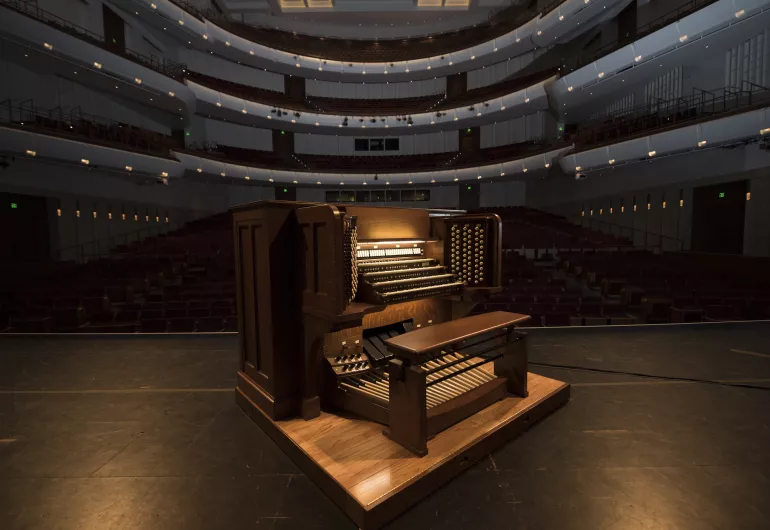
Photo by Patrick O'Leary.
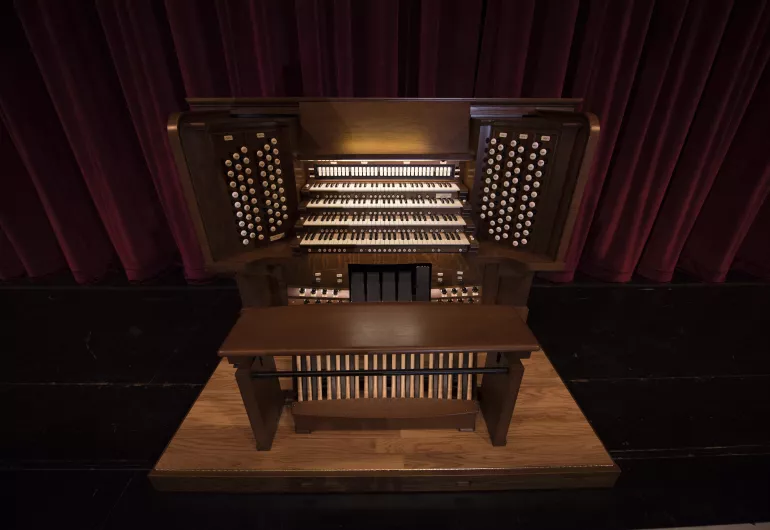
Photo by Patrick O'Leary.
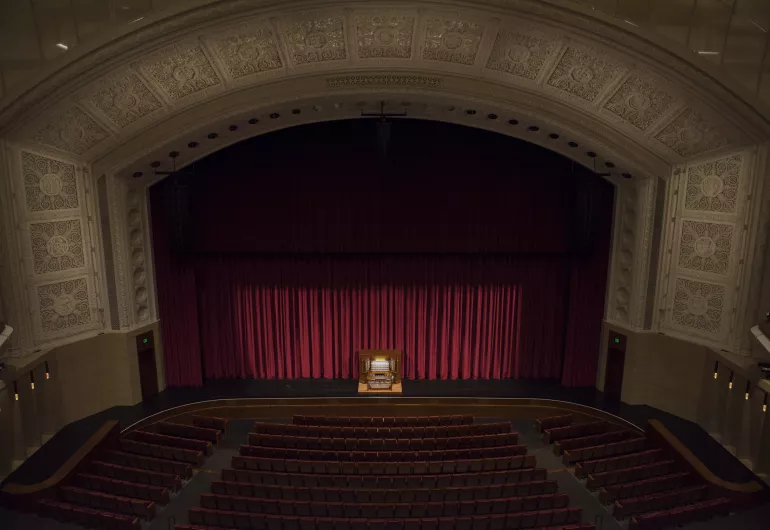
Photo by Patrick O'Leary.
16 Diapason
8 First Diapason
8 Second Diapason
8 Third Diapason
8 Flute Harmonique
8 Gedeckt*
8 Viola*
8 Gemshorn
5-1/3 Quint
4 Octave
4 Second Octave
4 Flute*
3-1/5 Tenth
2-2/3 Twelfth
2 Fifteenth
VII Plein Jeu*
IV Harmonics
16 Contra Tromba*
8 Tromba*
4 Octave Tromba*
Harp
Chimes
Celesta
16 Bourdon
16 Gemshorn
8 Geigen Diapason
8 Hohlflöte
8 Rohrflote
8 Fluato Dolce
8 Flute Celeste
8 Salicional
8 Voix Celeste
8 Echo Gamba
8 Echo Celeste
4 Octave Geigen
4 Flute
4 Violina
2-2/3 Twelfth
2 Fifteenth
V Dolce Cornet
V Chorus Mixture
16 Posaune
8 French Trumpet
8 Cornopean
8 Oboe
8 Vox Humana
4 Clarion
Tremolo
Harp
Celesta
Chimes
16 Contra Viola
8 Diapason
8 Concert Flute
8 Cor de Nuit
8 Dulcet II
8 Dulciana
8 Unda Maris
4 Flute
4 Gemshorn
2-2/3 Nazard
2 Piccolo
1-3/5 Tierce
1-1/3 Larigot
III Dulciana Mixture
16 Fagotto
8 Trumpet
8 Orchestral Oboe
8 Clarinet
Tremolo
Harp
Celesta
16 Contra Gamba
8 Flauto Mirabilis
8 Gamba
8 Gamba Celeste
8 Aetherial Celeste II
4 Orchestral Flute
4 Octave Gamba
III Cornet de Viole
16 Corno di Bassetto
8 English Horn
8 French Horn
8 Tuba Mirabilis
4 Tuba Clarion
Tremolo
Harp
Celesta
32 Double Open Diapason
32 Sub Bourdon**
16 Diapason
16 Metal Diapason
16 Diapason (Gt)
16 Contre Basse
16 Contra Gamba (Sw)
16 Contra Viola (Ch)
16 Bourdon
16 Gemshorn (Sw)
16 Echo Lieblich (Sw)
8 Octave
8 Cello
8 Viole (Ch)
8 Gedeckt
8 Still Gedeckt (Sw)
5-1/3 Twelfth
4 Super Octave
4 Flute
V Harmonics
32 Bombarde
32 Contra Fagotto (Ch)
16 Trombone
16 Posaune (Sw)
16 Fagotto (Ch)
8 Tromba
4 Clarion
Chimes
Swell to Pedal
Great to Pedal
Choir to Pedal
Solo to Pedal
Swell to Pedal 4
Choir to Pedal 4
Solo to Pedal 4
Pedal to Great 8 ***
Swell to Great
Choir to Great
Solo to Great
Swell to Choir
Solo to Choir
Solo to Swell
Great to Solo
Swell 16
Swell 4
Swell to Great 16
Swell to Great 4
Swell to Choir 16
Swell to Choir 4
Choir 16
Choir 4
Choir to Great 16
Choir to Great 4
Solo 16
Solo 4
Solo to Great 16
Solo to Great 4
Manual Transfer ***
Pedal Divide ***
All Pistons Next ***
All Swells to Swell
Solid State Combinations by Classic Organ Works
18 General
8 Solo
10 Swell
10 Great
10 Choir
6 Pedal
300 Memory Levels per User; Multiple Users Possible
Sequencer
Transposer
* Enclosed
** Originally a Resultant below GGGG; 7 new pipes 2016 by FoleyBaker to complete the register.
*** Additions by Foley-Baker 2016


Limón Dance Company in “The Moor's Pavane” by José Limón.

Kate Wallich & Perfume Genius: “The Lesson.” Photo © Jayme Halbritter.

Marks of RED. Photo © Alex Apt.
Photo © George Lange.
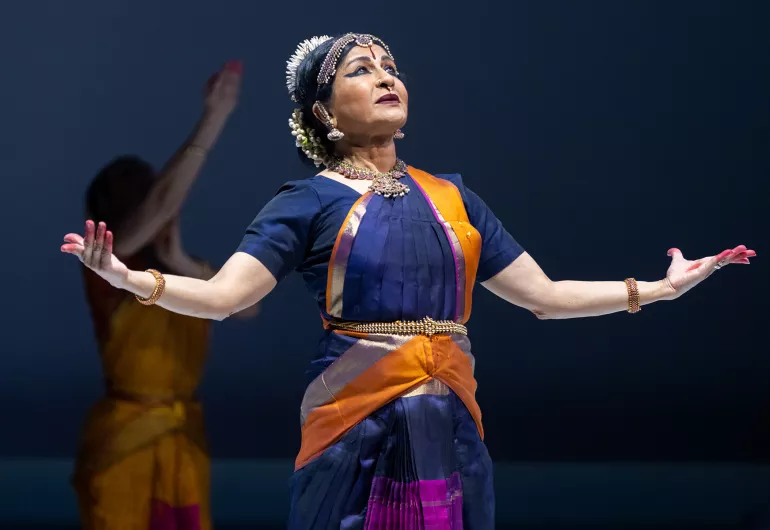
Photo © Luis Luque.

Photo © Paula Lobo.
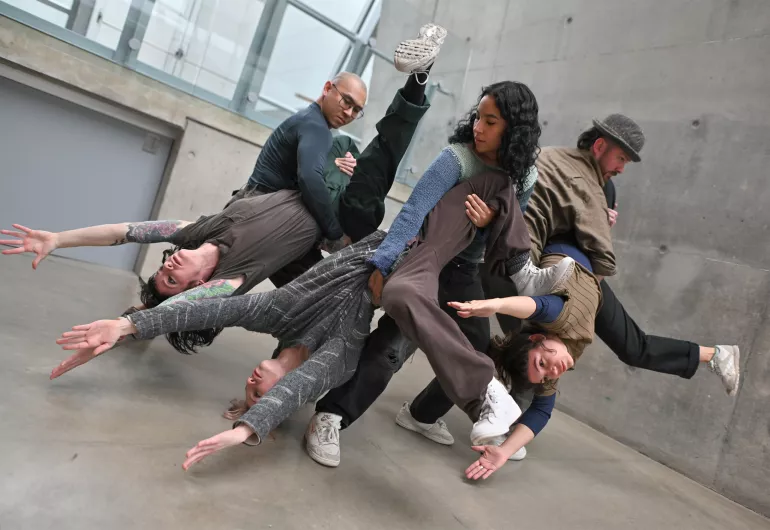
Photo © Shane Wynn.
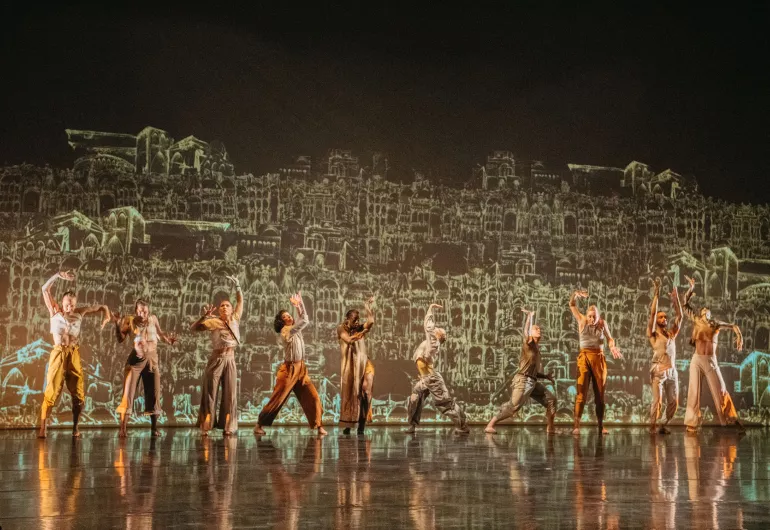
Photo © Jayme Halbritter Photography.
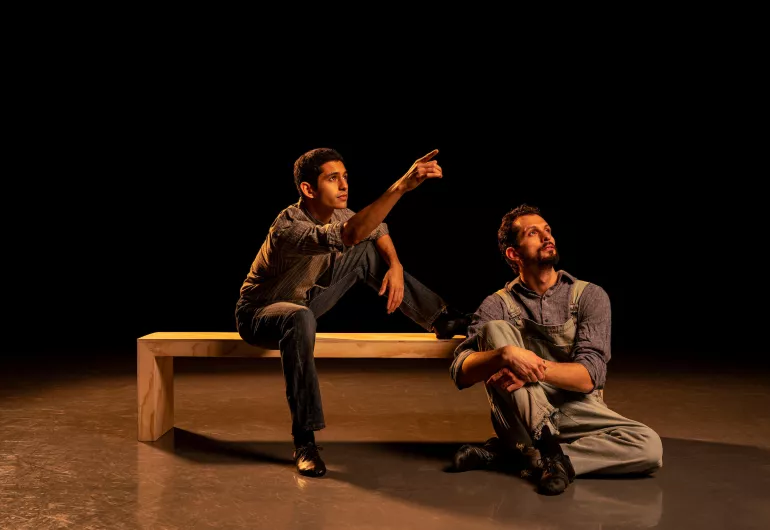
Xaiver Nunez and Dylan Gutierrez in Of Mice and Men. Photo © Todd Rosenberg.
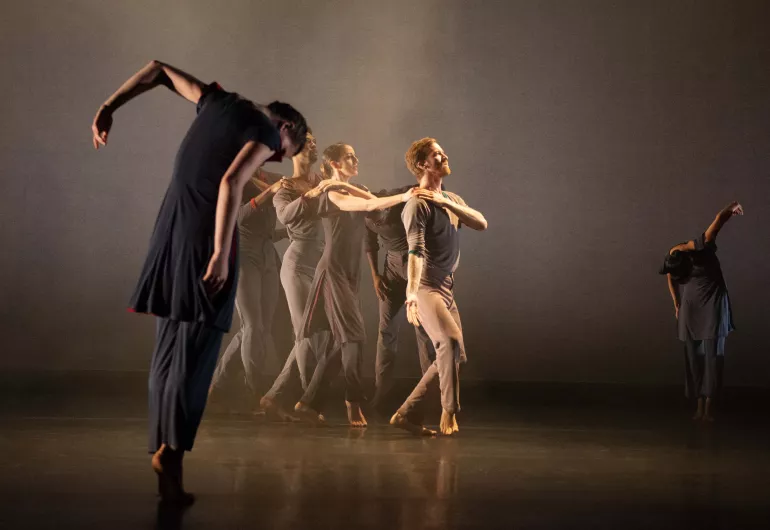
Photo © Psalm Joyce.
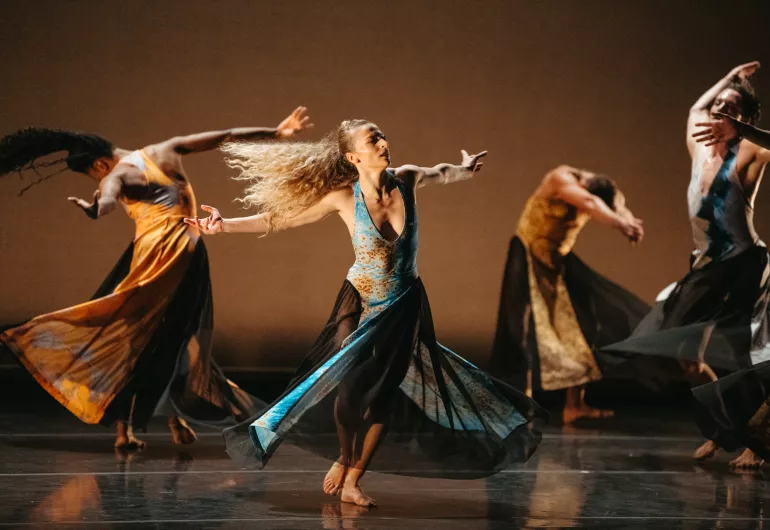
Martha Graham Dance Company in Canticle For Innocent Comedians. Photo © Jayme Halbritter Photography.

Paul Taylor Dance Company in A Call for Softer Landings. Photo © Jayme Halbritter Photography.
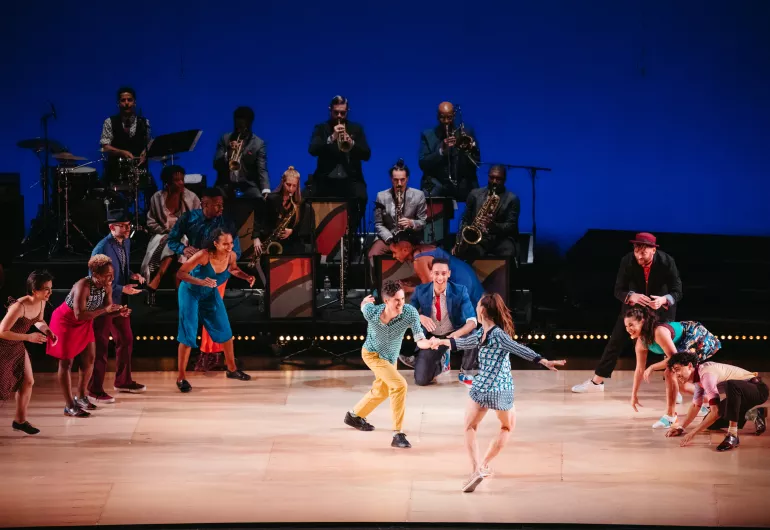
Photo © Jayme Halbritter Photography.

Kouadio Davis and Alexandra Hutchinson in Higher Ground. Photo © Theik Smith.

GALLIM in BOAT. Photo Courtesy of artist.

Ragamala Dance Company in Fires of Varanasi. Photo © Jayme Halbritter Photography.
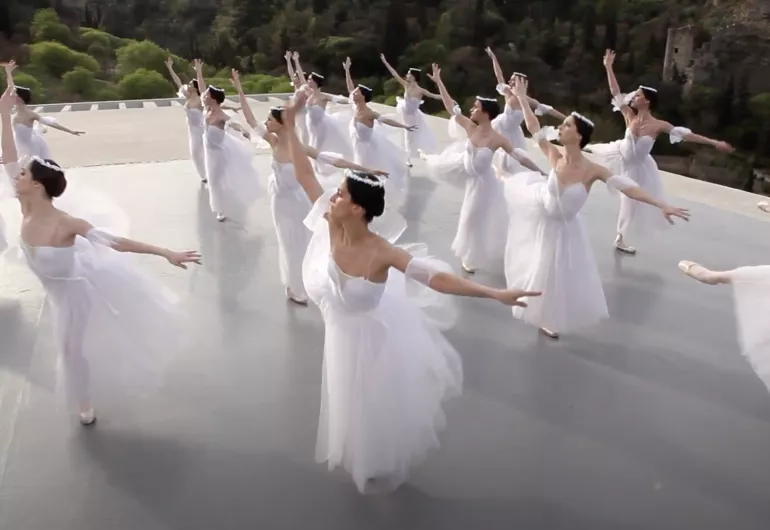
Photo still from the film The State Ballet of Georgia Today.